History of Luxury
Chanel: The Rise of Coco Chanel — From Humble Origins to the World's Most Iconic Fashion House | Timeless Elegance…
Explore History of Luxury: Chanel →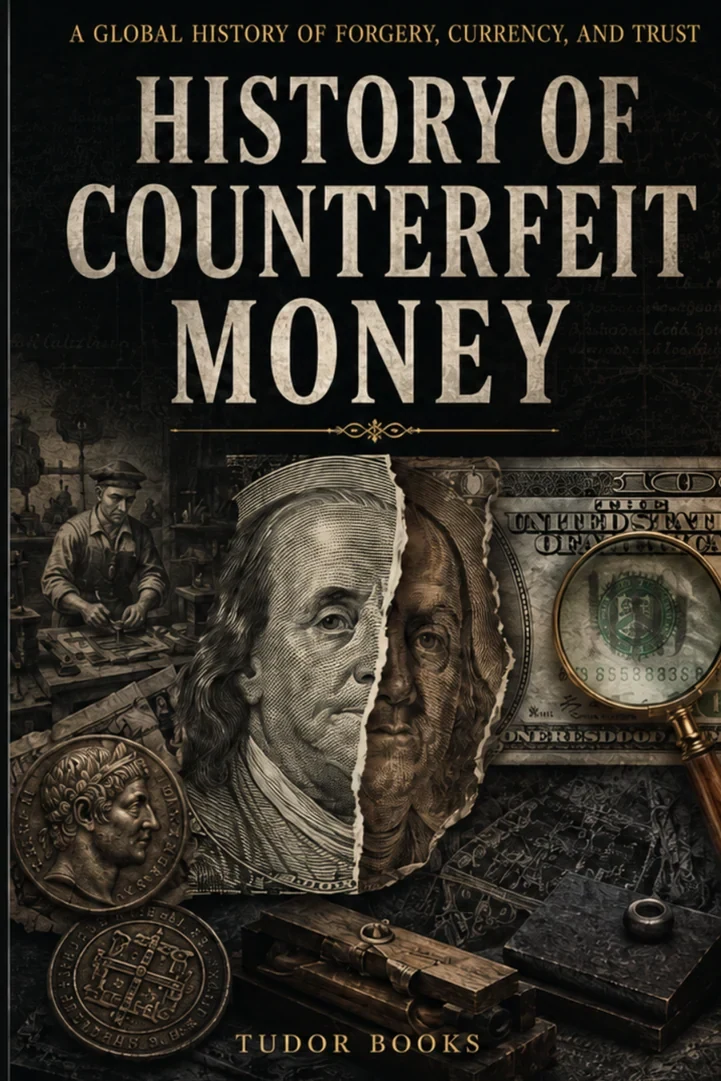
A Global History of Forgery, Currency, and Trust
Opens the Amazon store you pick. Price and availability are shown on Amazon.
History of Counterfeit Money follows the contest between forgers and the people trying to protect currency. From ancient tokens and Classical coinage to modern security technology and digital-era crime, the book explores how imitation tested economies and public trust. Read about the craft of deception, the response to it, and the changing meaning of money.
The manuscript treats currency as a promise that other people will accept it. Counterfeiting exploits that shared confidence, so the story has to explain both the methods of imitation and the defenses created in response. Its chronological reach includes early monetary forms, Classical coinage, Renaissance engraving, industrial production, and modern security technologies. War, revolution, and espionage appear alongside ordinary exchange.
Security devices are historical evidence in their own right. When issuers change a coin, note, engraving, or verification method, they reveal what kind of imitation worried them at that moment. The book's movement from physical money toward digital-era threats makes the problem of trust visible across very different technologies. It also brings together individual forgers and the institutions they challenged, so neither ingenuity nor enforcement is presented in isolation. For readers who know only a headline about a fake banknote, the broader narrative explains why counterfeiting is a recurring pressure on monetary systems.
The book's chapters connect the craft of the forger with the institutions that define authentic money. Readers can follow how a change in material or printing technique creates new opportunities and new tests, then consider what happens when money becomes less physical. This is history for people interested in economic trust, crime, technology, and the culture of payment. It examines the contest between deception and detection without presenting forgery as a practical how-to.
The fraud could disappear in a handful of beans. In a crowded Mesoamerican market, long before a bank clerk ever held a suspicious note to the light, a dishonest seller needed no press, no engraving plate, and no secret room full of ink. The object he hoped to pass was small enough to hide between two fingers: brown, dry, slightly wrinkled, and close enough in appearance to the cacao beans piled around it that a hurried buyer might never pause. Cacao was food, but in parts of Mesoamerica it also moved through markets as a valued commodity and, in some circumstances, as money. Beans were counted out in payment, carried, stored, and handed on again.
All 30 sections in the book.
The contents list 30 sections, shown in full on this page. The manuscript runs to roughly 105,000 words.
A Global History of Forgery, Currency, and Trust.
No. This page shows the contents and a short opening excerpt. The complete book is sold on Amazon (Paperback).
The book is sold on Amazon. Choose your country in the selector on this page to open the matching Amazon store.
Chanel: The Rise of Coco Chanel — From Humble Origins to the World's Most Iconic Fashion House | Timeless Elegance…
Explore History of Luxury: Chanel →The History of Whisky traces the spirit through Ireland, Scotland, America, Japan, and a changing global market.
Explore The History of Whisky →The History of Coffee begins with the bean's Ethiopian origins and follows the drink through Yemen, coffeehouses, European trade, plantations, global brands, and specialty roasting.
Explore The History of Coffee →Burberry: The Story of Britain's Most Iconic Fashion House
Explore History of Luxury: Burberry →