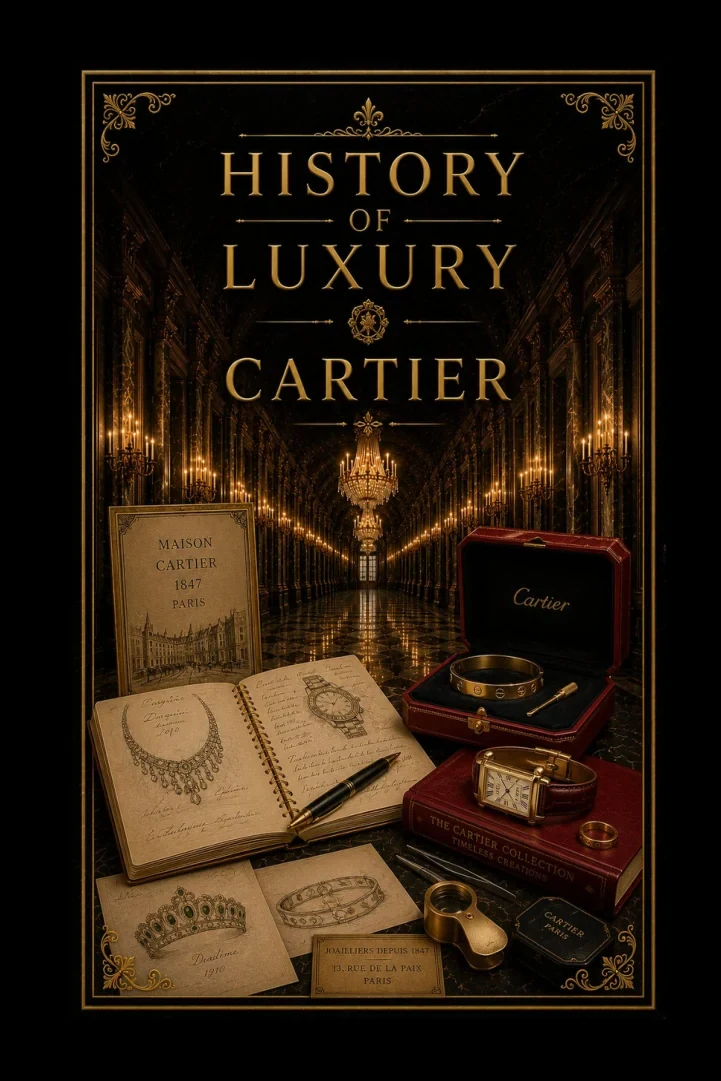
About History of Luxury: Cartier
History of Luxury: Cartier explores jewelry, watches, and the craft behind a celebrated Maison. From royal clients to the Tank watch, Love bracelet, and high jewelry, the story follows designs that made Cartier a lasting name. It connects artistic invention with the changing world of luxury.
The story begins with Louis-François Cartier's workshop in 1847 Paris and its first clients. Imperial patronage, Alfred Cartier's expansion, and the move to Rue de la Paix bring the firm into the international luxury world. Chapters on the next generation and European courts show how jewelry design became tied to reputation, relationships, and the ability to serve demanding patrons.
The manuscript also follows the Garland style, royal warrants, the London branch, and the Santos wristwatch. The cover names the Tank watch, Love bracelet, and high jewelry as later points of recognition. Across these examples, the book treats design and watchmaking as evolving crafts rather than as a fixed list of famous objects.
The book's expansion from a workshop to international clients is a history of trust as well as design. Royal patronage brought visibility, while watches and later jewelry lines asked the house to work across different scales and techniques. The chapter on the Santos wristwatch is especially useful for seeing how a particular object entered the story of modern wear. Later names on the cover, such as Tank and Love, extend that narrative. Readers can look beyond a famous red box to the family, craftsmen, and markets behind the image.
This independent Tudor Books history is for readers interested in jewelry, watches, Paris, and luxury commerce. It is not an official Cartier publication or a guide to purchasing or authenticating pieces. The chronological narrative gives context to the phrase “Jeweler of Kings” while following the workshop and the family behind it.