The History of Tea
The History of Tea follows a leaf from ancient China across Asia and into a global trade.
Explore The History of Tea →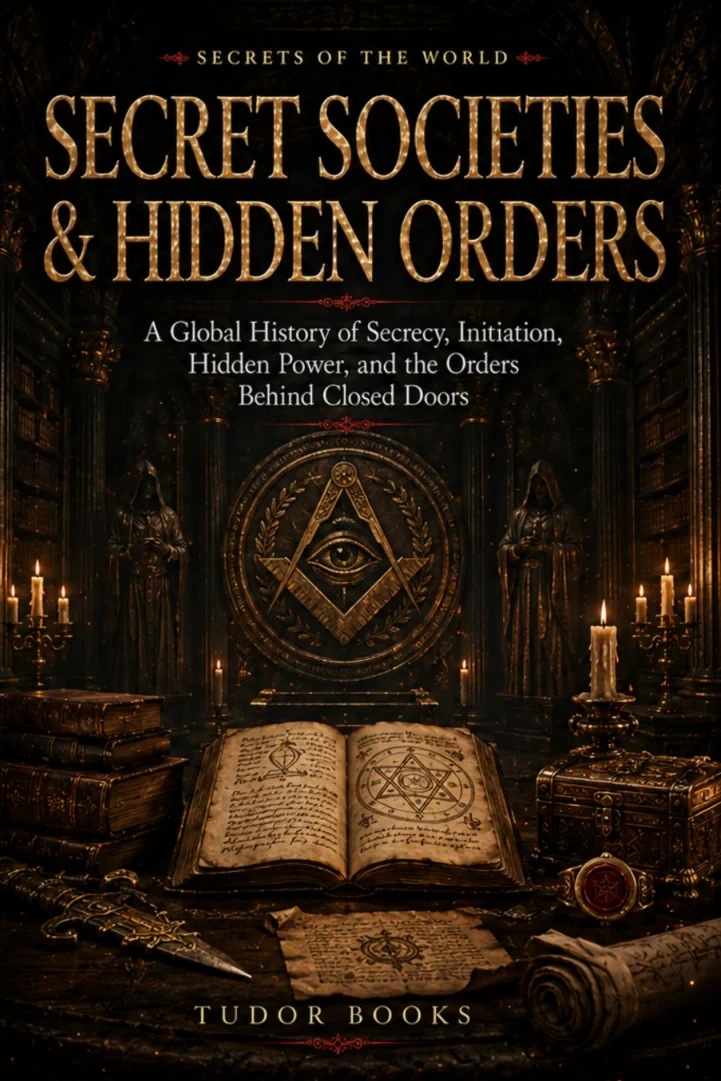
A Global History of Brotherhoods, Rituals, Power, and the Networks That Shaped the World
Opens the Amazon store you pick. Price and availability are shown on Amazon.
Secret Societies & Hidden Orders traces closed circles from ancient mystery cults and the Knights Templar to Freemasonry, elite clubs, and modern conspiracy culture. It examines rituals, networks, power, and the legends that gather around secrecy. The book separates documented history from the mythology of hidden influence.
The verified contents open with ancient mystery cults, Egyptian and Roman religious settings, Gnostic traditions, medieval guilds, the Assassins of Alamut, the Templars, Rosicrucian stories, and alchemical circles. These cases provide different models of secrecy: initiation, professional membership, protection from persecution, prestige, and later legend. The book also covers Freemasonry, elite clubs, intelligence networks, and digital conspiracy culture named on the cover.
The chapter sequence shows that secrecy can be a practice, a reputation, or an accusation. Medieval guilds controlled membership for reasons different from those of a religious initiation group; a modern conspiracy story can attribute power to an organization far beyond documented evidence. The book keeps those distinctions alive as it moves from ancient cults to later fraternities and contemporary networks. For readers drawn by the mystery, the historical value is learning which sources describe an actual group, which describe outsiders' fears, and how legends can survive long after an institution changes or disappears.
A reader interested in political and religious history can compare how a closed group actually operated with how outsiders imagined it. The book treats real institutions, ritual practices, and myths of hidden influence as related but distinct subjects. It does not ask readers to accept a single secret explanation for world events. Its global sweep is designed to show why secrecy attracts both power and speculation.
The candidate stands in the anteroom and cannot see what waits beyond the door. His eyes are covered with a cloth — the hoodwink, in the lodge’s terminology — and his left knee is bare where his trouser leg has been rolled. A rope hangs loosely around his neck. He has surrendered his metal objects: watch, keys, coins. Beside him stands a guide who calls himself the Inner Guard, and somewhere behind the closed door a voice is preparing a question he must answer correctly before the door will open.
All 40 chapters in the book.
The contents list 40 chapters, shown in full on this page. The manuscript runs to roughly 145,000 words.
A Global History of Brotherhoods, Rituals, Power, and the Networks That Shaped the World.
No. This page shows the contents and a short opening excerpt. The complete book is sold on Amazon (Paperback).
The book is sold on Amazon. Choose your country in the selector on this page to open the matching Amazon store.
The History of Tea follows a leaf from ancient China across Asia and into a global trade.
Explore The History of Tea →The History of Perfume follows scent from ancient ritual through classical worlds, distillation, French court culture, modern chemistry, fashion houses, and niche fragrance.
Explore The History of Perfume →The History of Fine Cheese explores a craft rooted in milk, place, and accumulated knowledge.
Explore The History of Fine Cheese →The History of Cigars traces tobacco from its long history in the Americas through the making, trade, and culture of cigars.
Explore The History of Cigars →