The History of Coffee
The History of Coffee begins with the bean's Ethiopian origins and follows the drink through Yemen, coffeehouses, European trade, plantations, global brands, and specialty roasting.
Explore The History of Coffee →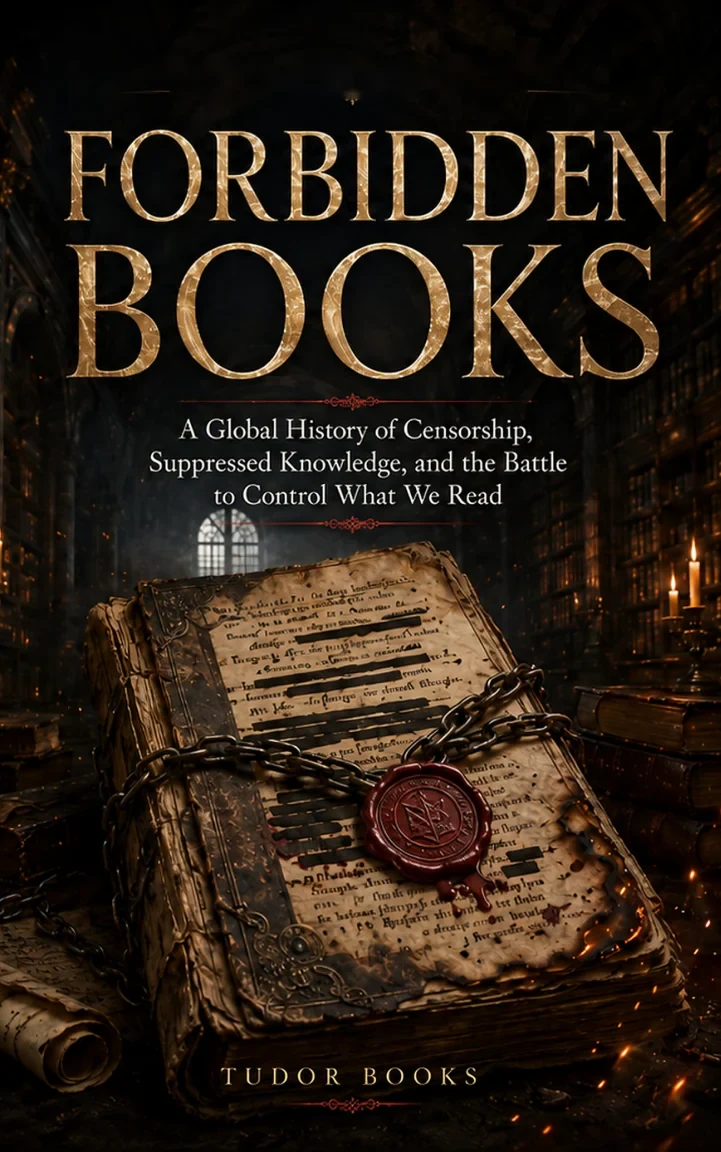
A Global History of Censorship, Suppressed Knowledge, and the Battle to Control What We Read
Opens the Amazon store you pick. Price and availability are shown on Amazon.
Forbidden Books traces the struggle over what people may write, read, and remember. Ancient archives, church indexes, revolutionary tracts, banned novels, and digital blacklists show how censorship has appeared across empires, religions, schools, and states. The result is a global history of suppression and the stubborn influence of ideas.
The manuscript's contents begin with early archives, famous ancient libraries, and the destruction or control of texts. Later chapters move through religious interpretation, imperial policy, and the many settings in which authorities have decided what may be copied or read. The cases make censorship concrete: the destruction of a collection, the restriction of a book, and the suppression of an idea do not all work in the same way.
The verified chapters on ancient libraries and book destruction show how much can disappear through war, neglect, or policy long before a formal banned-book list exists. Later restrictions can operate through licensing, religious authority, schools, or surveillance. The book follows these different instruments rather than assuming every ban has the same cause or effect. It also considers the afterlife of prohibited writing: some texts circulate secretly, some are copied into other forms, and some are known mainly through records of their suppression. Readers can use the examples to understand how control over access shapes cultural memory.
Readers interested in book history can follow how media, institutions, and power change over time. The history includes church indexes, revolutionary writing, banned novels, school disputes, and digital lists named in the cover presentation. It also asks what survives when a work is forbidden and what a prohibition reveals about the fears of its era. The book is a global narrative of control over reading and memory, with examples across empires, religions, schools, and states.
Before there were books, there was memory. Before there were libraries, there were men who remembered—and men who grasped, very early, that controlling what another person could know was a form of dominion more durable than any sword. Power over territory requires constant enforcement. Power over knowledge, once established, enforces itself. The ruled who do not know that alternatives exist, who cannot read the arguments against their rulers, who lack access to the accumulated record of how things might be arranged otherwise—these are subjects of a particularly stable kind. The history of forbidden books does not begin with ink or papyrus or the printing press. It begins in the moment when one human being first understood that the restriction of knowledge was a political act.
All 40 chapters in the book.
The contents list 40 chapters, shown in full on this page. The manuscript runs to roughly 145,000 words.
A Global History of Censorship, Suppressed Knowledge, and the Battle to Control What We Read.
No. This page shows the contents and a short opening excerpt. The complete book is sold on Amazon (Kindle eBook; Paperback).
The book is sold on Amazon. Choose your country in the selector on this page to open the matching Amazon store.
The History of Coffee begins with the bean's Ethiopian origins and follows the drink through Yemen, coffeehouses, European trade, plantations, global brands, and specialty roasting.
Explore The History of Coffee →Burberry: The Story of Britain's Most Iconic Fashion House
Explore History of Luxury: Burberry →The History of Tea follows a leaf from ancient China across Asia and into a global trade.
Explore The History of Tea →The History of Perfume follows scent from ancient ritual through classical worlds, distillation, French court culture, modern chemistry, fashion houses, and niche fragrance.
Explore The History of Perfume →