Greek Mythology Coloring Book
Gods, Monsters & Legendary Heroes | 35 Bold Illustrations with Mythology Stories | Single-Sided Anti-Bleed Pages |…
Explore Greek Mythology Coloring Book →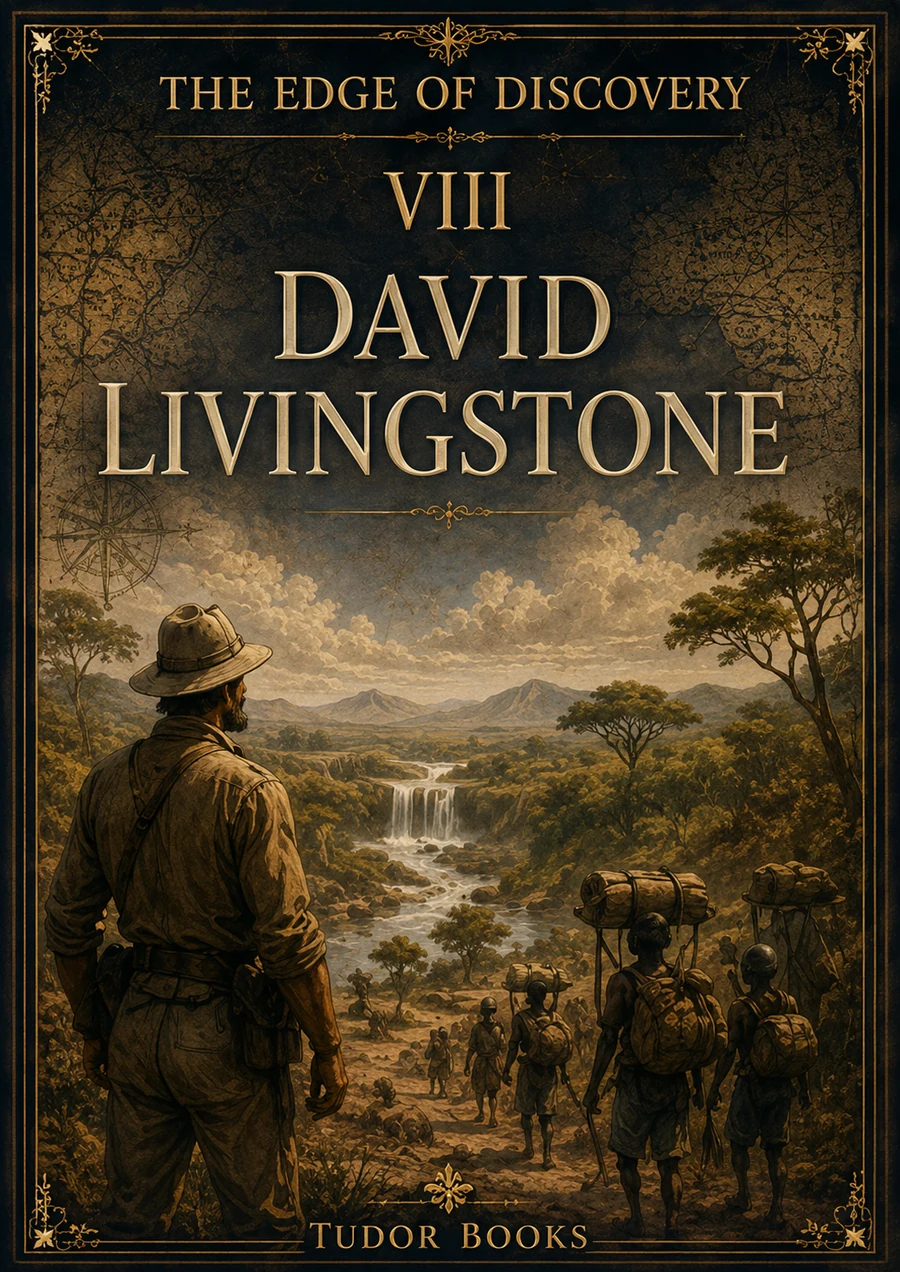
The Edge of Discovery: Mission, Exploration, and the Heart of Africa
Opens the Amazon store you pick. Price and availability are shown on Amazon.
David Livingstone: The Edge of Discovery follows the missionary and explorer through Africa and the maps Europeans struggled to complete. The narrative sets his journeys against African geography, societies, and the assumptions outsiders brought to the continent. It offers a historical account of exploration and its complicated context.
The manuscript opens by questioning older European descriptions of Africa, then follows Livingstone from Blantyre through faith, medical training, and missionary ambition. The Cape, Kuruman, Mabotsa, Kolobeng, and the Kalahari appear as real settings with their own communities and histories. Chapters on Mary Moffat and family decisions make the account personal as well as geographic.
Lake Ngami, the Zambezi vision, and journeys between Linyanti, Luanda, and the Indian Ocean carry the narrative into the interior. The chapter titled “The Smoke That Thunders” marks a famous waterfall within that longer travel story. By tracing the route and its context, the book shows how mission, medicine, mapping, and imperial interests became intertwined.
Livingstone's medical and religious ambitions help explain the routes he pursued, but the manuscript also records how African communities, guides, and landscapes shaped what was possible. Journeys across the Kalahari and between coasts were not movements through a blank map. Family separations, mission-station limits, and the practical challenge of travel give the account human scale. For a reader familiar only with a waterfall or the later Stanley meeting, this earlier sequence adds necessary context. The book situates a famous explorer within the nineteenth-century forces of mission, science, commerce, and empire.
Readers interested in African exploration and nineteenth-century biography will find a chronological account that does not treat the continent as uninhabited terrain. Livingstone's activities and reputation are set against the places and people involved. The Edge of Discovery format also encourages comparison with other explorers whose journeys had different motives and consequences.
On a sheet of engraved paper produced in a London workshop in the years around Livingstone's birth, the coastline of Africa was drawn with confidence while the interior was left almost wholly blank. Cartographers knew the great rivers where they reached the sea, the harbours where European ships took on water and ivory and human cargo, and the names of a handful of inland kingdoms recorded by travellers who had rarely set eyes on them. Beyond that coastal fringe the paper was either empty or filled with conjecture, a mountain range guessed at, a lake set down by rumour, a river that began nowhere certain and was made to end in the wrong ocean.
All 40 chapters in the book.
The contents list 40 chapters, shown in full on this page. The manuscript runs to roughly 195,000 words.
The Edge of Discovery: Mission, Exploration, and the Heart of Africa.
No. This page shows the contents and a short opening excerpt. The complete book is sold on Amazon (Paperback).
The book is sold on Amazon. Choose your country in the selector on this page to open the matching Amazon store.
Gods, Monsters & Legendary Heroes | 35 Bold Illustrations with Mythology Stories | Single-Sided Anti-Bleed Pages |…
Explore Greek Mythology Coloring Book →A Calming Picture Book for Seniors: Beautiful Scenes to Imagine, Remember and Share for Older Adults with Dementia…
Explore Dream Away →Exact First Messages and Replies to Break the Ice on Tinder, Instagram, Facebook and in Real Life
Explore What Do I Say First? →