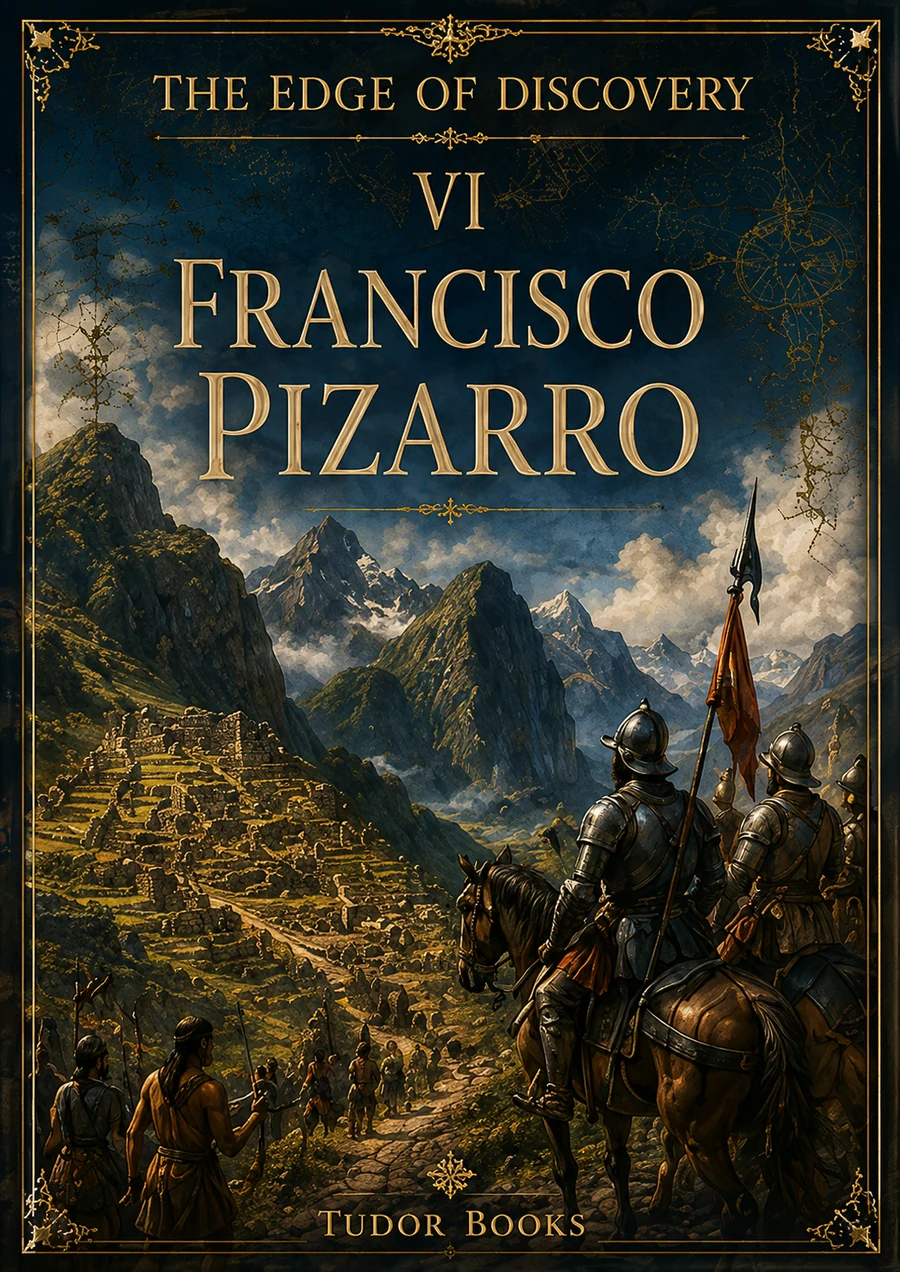
About Francisco Pizarro
Francisco Pizarro: The Edge of Discovery places the conquest of the Inca Empire against the history of the Andes before Spanish arrival. The narrative explores the world Pizarro entered and the upheaval that followed. Its focus on setting and encounter gives readers a fuller frame for a consequential chapter of exploration and conquest.
The first chapter introduces the Inca world before Pizarro enters it. His childhood in Trujillo, travel across the Atlantic, and years around Panama then lead to partnerships and failed attempts to reach the western coast of South America. The Island of Gallo and the first glimpse of Peru show that the later conquest followed uncertainty and repeated preparation, not a straightforward march.
The manuscript continues through the Capitulation of Toledo, a third expedition, and the Inca Empire's internal crisis. Landing on the coast, the movement toward the Andes, Atahualpa, and Cajamarca form a sequence of encounters with enormous consequences. The chapters on imprisonment, ransom, and the death of Huáscar keep the conflict's political and human stakes visible.
The Inca Empire's crisis is an essential part of the historical setting, but it does not make the conquest a simple matter of Spanish skill. The manuscript's sequence through coastal contact, the Andes, Atahualpa, and Cajamarca lets readers see how information, alliances, coercion, and misunderstanding unfolded. It also puts the ransom and the fate of Huáscar inside a broader political struggle. The story asks readers to examine the language of “discovery” and “conquest” critically while following specific events. It is a biography connected to an empire's destruction, not an adventure divorced from its costs.
Readers interested in the conquest of the Americas can use this narrative to see events from both the Spanish expedition's timeline and the setting it entered. The book does not reduce the Inca Empire to an obstacle in an explorer's story. It is a focused historical volume that makes the ambitions, alliances, violence, and aftermath of conquest central to understanding Pizarro.