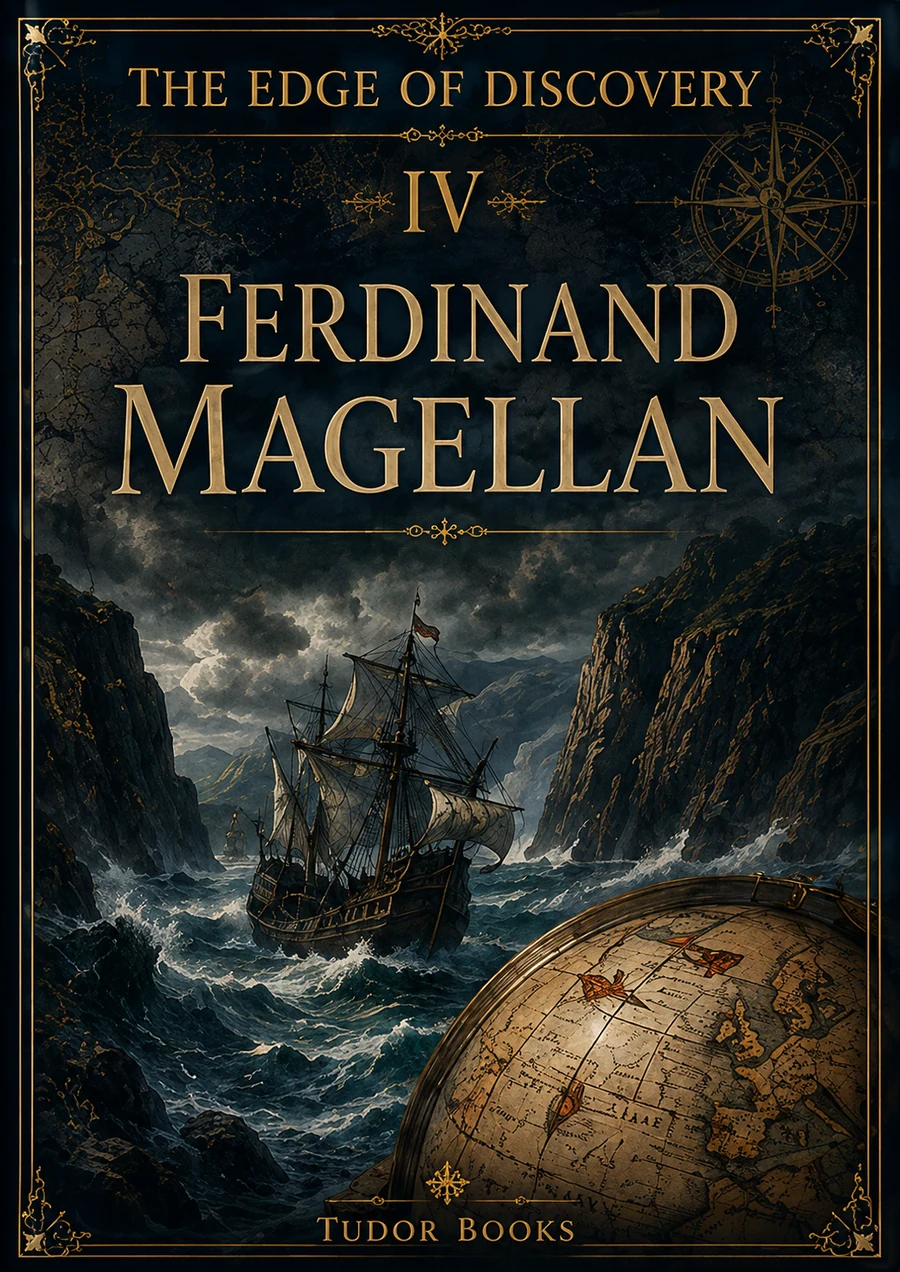
About Ferdinand Magellan
Ferdinand Magellan: The Edge of Discovery follows the expedition associated with the first voyage around the world. The story begins with rival ambitions, uncertain maps, and the division of ocean routes between empires. It examines the people, decisions, and consequences behind a journey that changed geographical understanding.
The book begins with competing claims about how the world was divided and with Magellan's upbringing in Portugal. Service in the eastern empire, Malacca, and his connection with Francisco Serrão shaped his interest in the Spice Islands. A break with Portugal and support from Spain turn a theory of a western passage into a fleet, the Armada de Molucca, whose divisions existed even before departure.
The Atlantic crossing leads to Brazil, the Río de la Plata, Patagonia, and winter at Port San Julián. The chapter sequence then follows the search for a passage and the wider voyage that became the first circumnavigation. Calling it Magellan's voyage does not imply that he personally completed the circuit; the book examines the expedition, its crew, and the world that made the route valuable.
The chapter list makes clear that the route was a problem of geography and power at the same time. Portugal and Spain sought access to the Spice Islands under competing claims, and the fleet itself carried tensions between commanders. A westward plan had to survive uncertain coasts, winter, limited supplies, and the crews' doubts. The narrative does not require readers to know nautical history in advance; it explains why each stage mattered. The circumnavigation that resulted belongs to the expedition and the sailors who completed it, a distinction worth keeping when the voyage is summarized under Magellan's name.
This volume is for readers of ocean navigation and the early global trade in spices. It connects maps, politics, ships, and decisions made under severe uncertainty. The chronological narrative is useful for understanding why the voyage mattered and why the familiar phrase “first voyage around the world” needs the context of everyone who sailed and survived it.