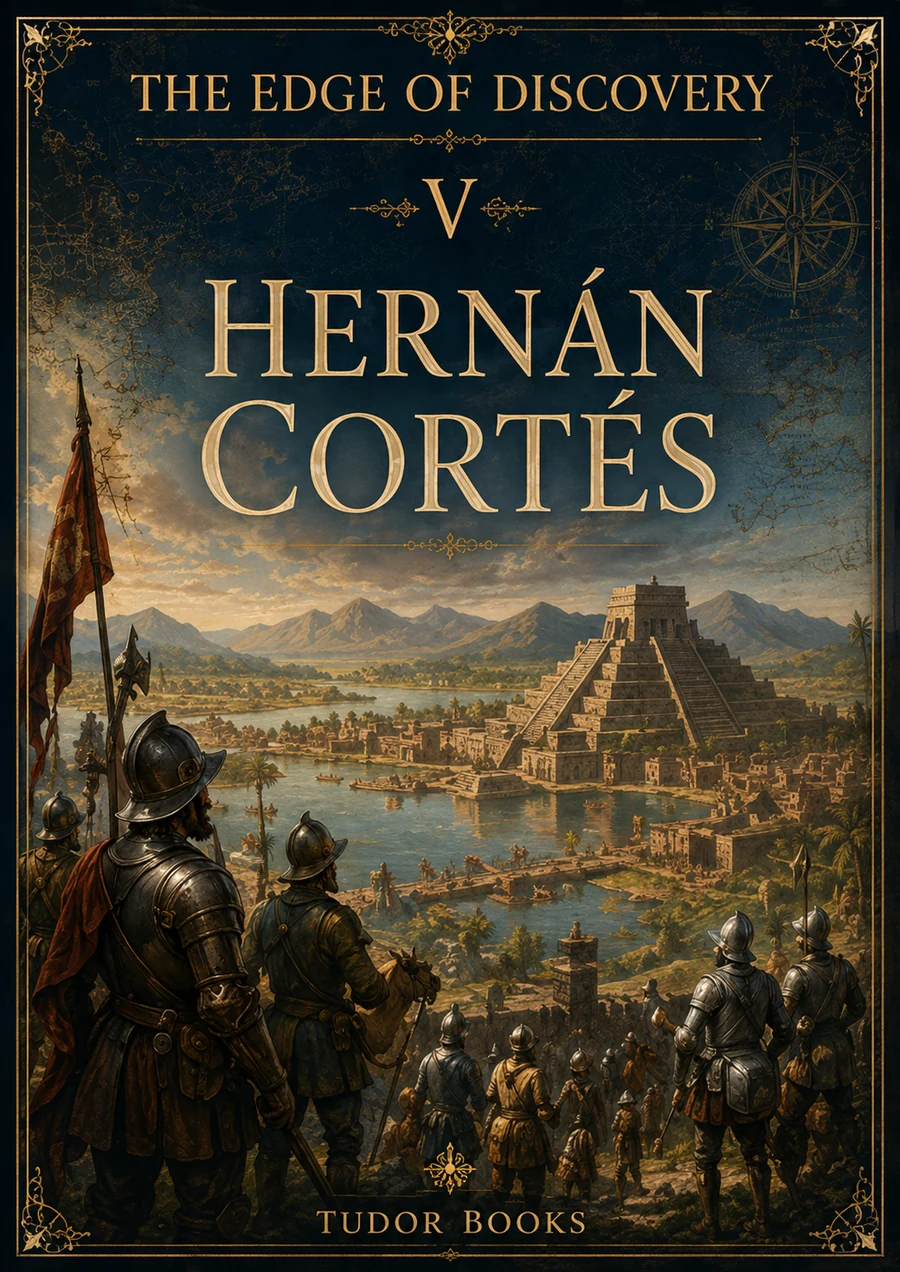
About Hernán Cortés
Hernán Cortés: The Edge of Discovery examines the conquest of the Aztec Empire as an encounter between already complex worlds. Beginning with societies and power structures before Spanish arrival, the narrative follows the violent collision and its consequences. It asks readers to look beyond the familiar language of discovery.
The opening chapters introduce a world before Spanish and Mexica societies collided, then follow Cortés from Medellín through Hispaniola and Cuba. His break with Diego Velázquez, arrival at Yucatán, and fighting in Tabasco show the political and military uncertainty of the expedition. Malintzin and the foundation of Veracruz are central to the story of communication, alliance, and claims to authority.
The movement inland brings resistance and alliance in Tlaxcala, events at Cholula, and the approach to the Valley of Mexico. Moctezuma appears within his own political setting, rather than only as a figure in a Spanish account. The chronological chapters let readers follow decisions and shifting relationships before and during the conquest of the Aztec Empire.
The inclusion of Malintzin and the Tlaxcalan alliance prevents a story in which only Spanish decisions mattered. Translation, Indigenous politics, and local opposition shaped the march toward Tenochtitlan. The first eighteen chapter titles alone show a chain of distinct encounters, from Yucatán and Tabasco to Veracruz, Tlaxcala, Cholula, and the Valley of Mexico. The book's value lies in slowing that chain down. Readers can see conquest as a series of decisions and conflicts involving many people, with consequences that reached far beyond Cortés himself.
This book is for readers who want a narrative of conquest with attention to the Indigenous world it transformed. It considers ambition, translation, violence, and alliances rather than presenting victory as inevitable. As an Edge of Discovery volume, it also raises the broader question of what “discovery” means when a place and its societies were already known to those who lived there.